The US has declared a public health emergency over the spread of the coronavirus and said it would deny entry to any foreign nationals who have visited China in the past two weeks (BBC).
It has been reported that US citizens returning from Hubei province, where the outbreak started, will be quarantined for 14 days (BBC). The epicenter of the outbreak is the Hubei province in China, since then the province has been on lock down no one is to go in or out.
With the hype of this “possible pandemic” it seems as though the US has forgotten of its’ own relentless flu. Let us not forget that influenza has plagued humankind for centuries and with its highly variable nature, may continue to do so for the foreseeable future.
Each year, flu epidemics cause 3 to 5 million cases of severe illness and about 290,000 to 650,000 deaths around the globe, according to the World Health Organization (WHO) (History).
One hundred years ago, a new influenza virus appeared and swept across the globe, killing between 50 and 100 million people. Two NIAID experts, Dr. Jeffery Taubenberger and Dr. David Morens, discuss why the 1918 flu was so deadly, and what resurrecting the virus from preserved tissues has taught us (NIAID).
It seems as though the entire world is thinking of the worst possible outcome for this coronaviris. Although, there have only been a little over 400 deaths internationally, the initial US outbreak was reported on January 21, 2020 according to the CDC. The first confirmed instance of person-person-spread with this virus in the U.S. was reported on January 30, 2020 (CDC).
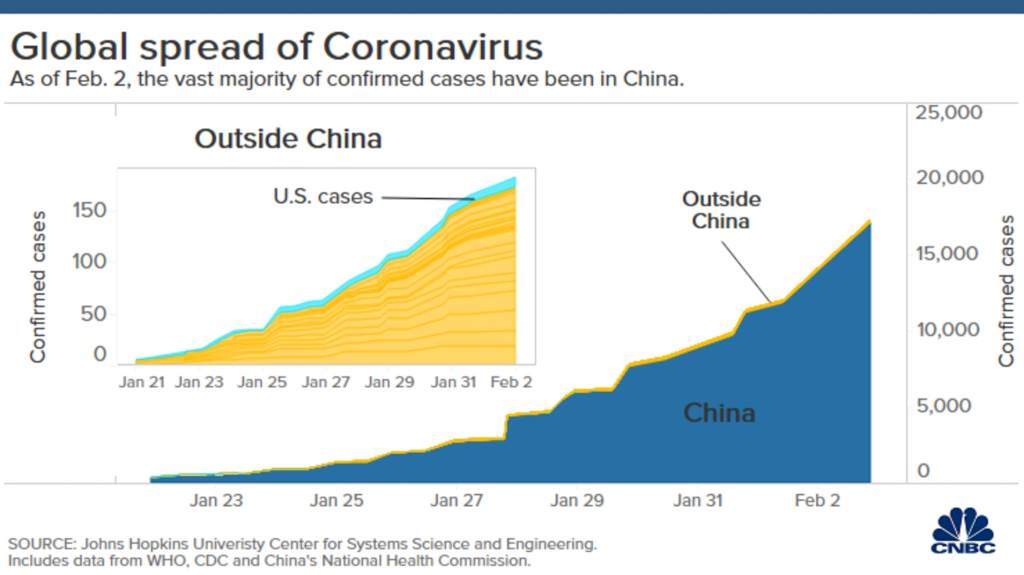
Estimates by the University of Hong Kong suggest the true total number of cases could be far higher than official figures suggest. Based on mathematical models of the outbreak, experts there say more than 75,000 people may have been infected in the city of Wuhan alone, where the virus first emerged (BBC).
It is unfortunate the media continues to highlight the “possible pandemic” and underexpose the flu, which has already killed 10,000 across the US, this year. In this video, NIAID experts Dr. David Morens and Dr. Jeffery Taubenberger discuss how a similar pandemic could emerge today–and what scientists are doing to prevent it (NIAID).
The two viruses have similar symptoms, which some health officials fear will cause misdiagnoses. Common flu symptoms include fever, cough, sore throat and aches. Coronavirus symptoms include fever, cough and shortness of breath, according to the CDC (CNBC).
Is the coronavirus the new 1918 pandemic? Somehow the 1918 virus which developed from birds infected the human population and it is known that most cases of influenza have mutated from the original “Mother of All Pandemics.” Because its descendants still occasionally resurface as pandemic influenza viruses today, maybe resulting in the newest coronavirus.
For now, it seems as though the US should be focused on the flu, which affects children and elderly individuals. Get a flu shot, wash your hands and stand a couple feet away from those you believe are sick.
 Jasmine's Blog
One thought on “Similarities among the coronavirus and the “Mother of All Pandemics””